Our film follows a young man who develops writer's block and experiences something of mental decline brought on by his stress; leading to various illusions and loss of concept of time and physics. Although this may read as something quite exuberant and lively, we aim to keep it fluid and somewhat bleak. In this sense, our film would (probably) not be entirely convenional of more popular psychological thriller. Also, as mentioned before, we hope to shoot our film in a noir-style which would further stray us away from the common conventions of psychological thrillers.
However, this is not to say that our film wont adopt many conventions of psychological thrillers.
Some conventions of psychological thrillers:
- Shadows- The use of shadows in psychological thrillers is a prominent element. Particularly used to create suspense and a sense of mystery. Shadows can make for an unsettling scene, especially when used to mask a character's identity or emphasise the fact there is something unknown in a scene. Because we aim to shoot in a noir style, we will be able to experiment grately with the use of shadows with various lighting techniques

- Illusions/hallucinations- Another consistent feature used is psychological thrillers. Often used to show the mental decline of characters. Hallucinations are also used to add an element of shock and thrill as they create an odd mixture of surrealism and realism. The concept of a hallucination is of a surrealistic nature and what may be seen by the character may also be very surreal. However, by seeing the environment how the protagonist (or any character realy) may see it creates a greater sense of realism as it puts you 'in the same shoes' as the character.

The Shining: The Shining (1980, Dir. Stanley Kubrick) is more of s horror than a psychological thriller, however the exploration of mental decline is still prominent and the film shares much of its iconography with that of psychological thrillers. In this scene from The Shining (right), Danny ((Danny Lloyd) out of shot) is exploring the hotel when he sees two twins at the end of a hallway. It is assumed that this is a hallucination as the twins dissappear after a while. Moroever, there is an occasional quick change to a shot of the twins laying dead in the hallway surroumded by a huge amount of blood. This creates a huge element of shock and also sight into the characters mind.
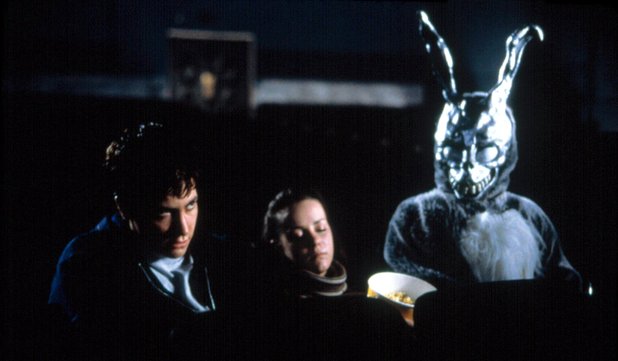 Donnie Darko: Donnie Darko (2001, Dir. Richard Kelly) is, again, not just of the psychological thriller genre but more of a Sci-Fi. However, due to the films plot it is very hard to distinguish that it is a Sci-Fi due to various complexities in narratives which includes many psychological thriller elements. The most noteable compnent of Donnie Darko is Frank (left, the giant rabbit). He is a hallucination of Donnie (Jake Gyllenhaal) (boy in picture), who makes him perform various acts. Frank is a character used to drive the entire narrative of the film and is the cause of every key point of the film.
- Mental Decline- The exploration of the decline of a character's mental state is an obvious feature of psychological thrillers, hense the name. It is usually the psychological troubles of the protagonist which are the drive of the stories. Psychological thrillers vary in their reasons for the loss of mental stability and there isn't much of a specific, common reason. Our film is based on a man having Writer's Block which causes his mental decline, similar to The Shining.
> Post Traumatic Stress (Jacob's Ladder, 1990. Dir. Adrian Lyne)
> Obsession over finding a certain number (Pi, 1998. Dir. Darren Aronofsky)
> Amnesia and the hunt for a murderer of protoganists wife (Memento, 2000. Dir. Christopher Nolan)
>Loss of family (Shutter Island, 2010. Dir. Martin Scorcese)

No comments:
Post a Comment